
You found a market that feels perfect for your business. You fill out the application, submit your fee, upload a few photos of your work and wait.
Then the rejection email arrives.
If it's a juried market, that rejection doesn't necessarily mean your products weren't good enough. Understanding how juried events work, and what organizers are trying to build, can help you put together a much stronger application.
First, what is a juried event?
A juried event is one where vendors are selected through an application and review process. Event organizers or a panel of jurors evaluate applicants before deciding who will be invited to participate.
Some events are non-juried and accept vendors on a first-come, first-served basis or as long as they meet basic event requirements. Juried events are intentionally more selective.
Why? Because organizers aren't only filling booth spaces. They're curating the overall shopping experience.
A well-juried market aims to offer customers a strong mix of products and price points while maintaining the quality and point of view of the event. Organizers may also limit the number of vendors within individual categories so shoppers don't walk into a market with 20 jewelry booths, 15 candle companies and very little of anything else.
Every event has its own criteria, but juries may consider things like:
Quality and craftsmanship
Originality and uniqueness
Fit with the event's audience or aesthetic
Professionalism and presentation
Overall product assortment
How your work compares with other applicants in your category
Whether the event already has enough vendors offering something similar
That last point is important. A strong application can still be declined. If an event receives 50 excellent jewelry applications and has room for 10 jewelry vendors, some very talented makers aren’t going to make the cut.
Your goal is to give the jury the clearest, strongest representation of your business possible.
And that's where your photos become incredibly important.
Your photos are the jury's first experience with your work
A jury doesn't get to stand in your booth, pick up your products, feel the materials, examine the craftsmanship up close, or hear you explain what makes your work special.
They have your application - and your photos.
That makes the images you submit one of your best opportunities to communicate the quality of your work, your point of view as a maker and the professionalism of your business.
Application photos have a different job
The beautiful lifestyle photo you created for Instagram may be perfect for marketing your business and still be the wrong choice for a vendor application.
Marketing photography can create a mood, tell a story, show a product in use, or make someone stop scrolling.
Application photography needs to help a jury evaluate your work.
Your product should be easy to see. Details should be clear. Lighting should accurately represent colors and materials. Backgrounds shouldn't compete with the product itself.
You don't necessarily need professional photography. You do need photos that look professional.
Show your strongest work
Think about your application photos as a small portfolio.
Choose products that represent the work you actually plan to bring to the event and, together, tell a cohesive story about your business. Look for consistency in quality, style and craftsmanship.
This is also a good time to retire application photos you've been submitting for years. If your products, branding or craftsmanship have evolved, your application should reflect the business you have today.
And be selective. A jury reviewing hundreds of applications doesn't need to see everything you make. Your strongest work deserves the spotlight.
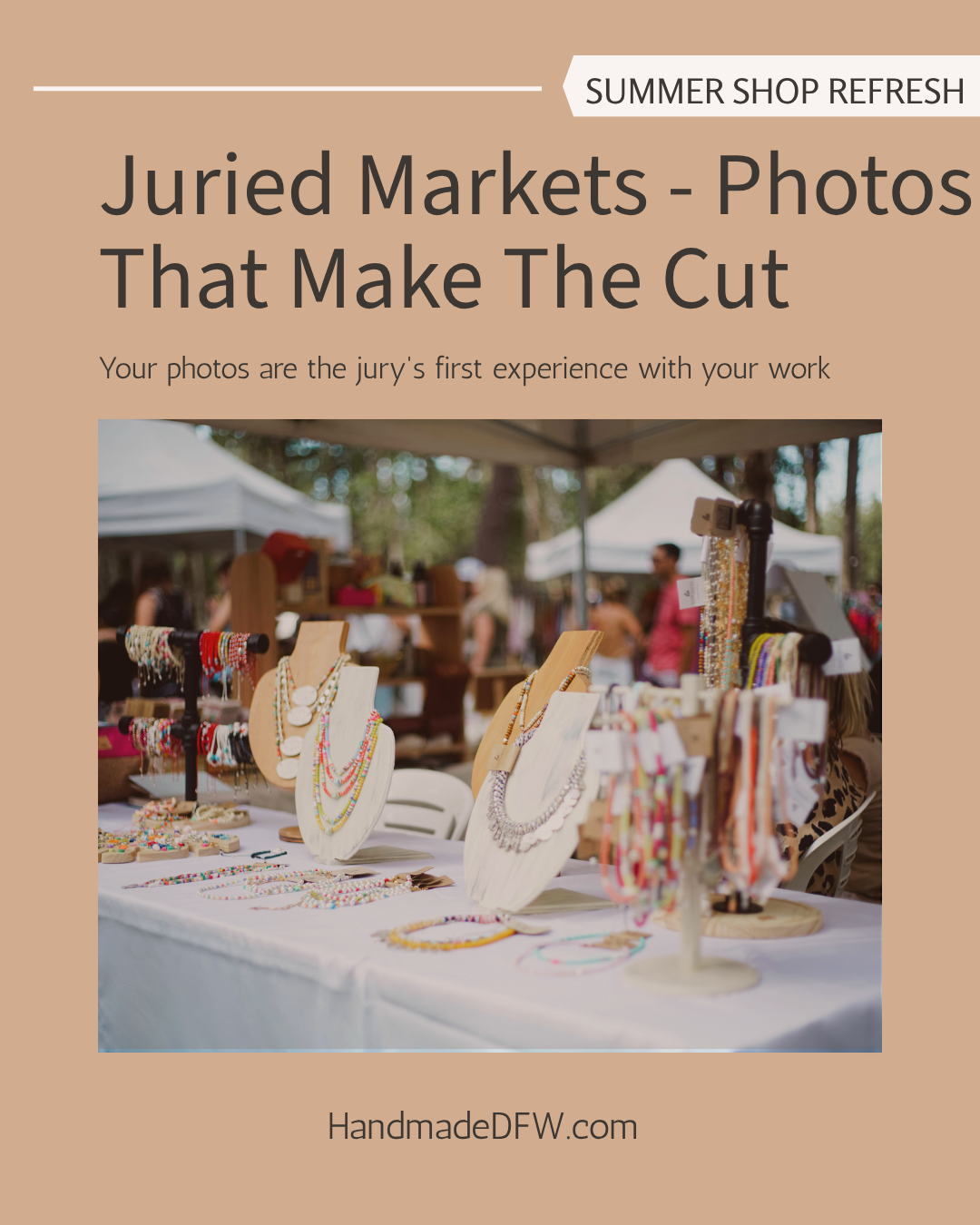
Don't overlook your booth photo
If an application asks for a booth photo, consider what the organizer is trying to learn from it.
Your booth photo gives them a preview of what their event will look like with your business in it.
The easiest way to do this is to remember to take some photos of your booth after you set it up for an existing market, before it opens. If this is your first market, set up your booth as if you were at a market in your yard or driveway as a practice run.
Is your booth clean and organized? Are products well stocked? Are displays cohesive? Is your signage professional? Do your fixtures complement your products? Can someone immediately understand what you sell?
Pay attention to the little things, too. Straighten products, remove boxes and personal items, hide cords and make sure everything visible in the frame feels intentional.
Review your application like a jury member
Before you hit submit, pull up all of your application photos together.
Then imagine you're seeing the business for the first time.
Do the images feel cohesive? Can you clearly see the quality of the work? Does the assortment feel intentional? Does the booth look ready for a professional event?
Most importantly, ask yourself:
If I were reviewing hundreds of applications, would these photos make me stop and take a closer look?
You can't control how many makers apply, how many spaces an event has available, or what assortment the organizers need that year.
You can make sure your application gives your work the best possible opportunity to stand out.